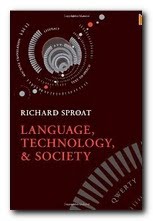
 Most people think that writing and speaking a language are more or less the same thing - that writing is speech transcribed onto paper. The fact is that they are two different (though closely related) systems, and writing is an abstract system of symbols for representing the spoken language. There are some languages which are spoken but which have no written equivalents, and there are some languages (computer code for instance) which are never likely to be spoken. Richard Sproat, in this wide-ranging study, emphasises from the start that the most important connection between speech and the written language is the technological invention of writing. He takes the radical line that most written languages have built into them a strong element of encoding the sound of the language - including even Chinese, which many people imagine to be entirely ideographic... more >>
Showing posts with label digital technology. Show all posts
Showing posts with label digital technology. Show all posts
04 June 2010
Language, Technology, and Society
Most people think that writing and speaking a language are more or less the same thing - that writing is speech transcribed onto paper. The fact is that they are two different (though closely related) systems, and writing is an abstract system of symbols for representing the spoken language. There are some languages which are spoken but which have no written equivalents, and there are some languages (computer code for instance) which are never likely to be spoken. Richard Sproat, in this wide-ranging study, emphasises from the start that the most important connection between speech and the written language is the technological invention of writing. He takes the radical line that most written languages have built into them a strong element of encoding the sound of the language - including even Chinese, which many people imagine to be entirely ideographic... more >>


15 May 2010
eBook Readers - comparison chart

Kindle eBook Reader Main features: 6" diagonal E Ink® electronic paper display - weight 10 ounces (290 grams) - 1.5 GB storage - USB 2.0 port - supports multiple ebook formats - download via free built-in WiFi - 2 weeks battery life (reading) - holds up to 1,500 books - UK=£176 ... Comparison chart >>
13 July 2009
Art and Technology
 I'm just in the middle of reading a biography of Stravinsky, and thinking how difficult it was for such an artist to hear his work performed. He composed by writing on paper, usually sitting at the piano; then had to transcribe what he wrote (using an amanuensis) for realisation by an orchestra. This needed to be assembled and paid for, which usually required a huge dontation from some patroness or another - and then further expense was incurred if the work was performed in public.
Today a composer needs only a simple laptop and a bit of software - both virtually free of charge. The results of composition can be reproduced at every step of the way - at zero cost. Of course not many major artists have gone down this route. But the process has begun.
For instance, film directors Mike Figgis and David Lynch work with digital cameras which cost no more than a few hundred pounds, And the Internet is now packed tight with musicians offering samples of their music via sites such as MySpace. Some have bypassed conventional production and distribution routes altogether. They've gone straight from back bedroom recording and mixing to podcasting and their own sites.
Most writers continue to use the very low-tech materials of pen or pencil on paper. Some have migrated to the word processor - and others might even, unbeknown to me anyway, be experimenting with voice recognition dictating software.
Either way, the results can easily be assembled in digital form for editing and processing. Moreover, unknown writers can make their work available to unlimited numbers of online readers via blogs and web sites. They can also advertise their hard copy products if and when they make it into print - or meanwhile use print-on-demand.
I know very few who have found fame in this way (apart from the Belle de Jour case, which I continue to regard as dubious) but many creative writing sites exist, and the medium is brand new. Something may emerge before too long.
29 June 2007
The Myths of Innovation
 This is a book which seeks to de-bunk the myths of innovation. Most of us are brought up to believe that Isaac Newton discovered gravity when an apple fell on his head, and that Archimedes had a 'Eureka!' moment in his bath. Scott Berkun points out that neither of these two myths is true, and that almost all radical innovations come about as a result of years and years of research, failed attempts, and lots of hard work. He also points out that history is not only written by the victors, but that it commonly misses out the failures, wastes, and losses that go to make up a success. His telling example here is Rome, whose architectural glories are actually built on the ruins of a city that was previously burned to the ground... Read more >>
07 April 2007
Scandals in Classical Music
 Norman Lebrecht is a writer and pundit specialising in classical music who often appears on Radio 3 taking phone-in commentaries on what are supposed to be controversial topics such as "Should government subsidise the Arts?" and "Is the Internet taking over from print journalism?". He comes across in the spoken word as a pushy and self-aggrandising windbag, but I must say that in print the same approach makes for lively reading. What he offers here is a history of recording classical music, from its faltering start at the beginning of the last century, to the present. His main argument is that what was at first perceived as a somewhat impure medium gradually took hold of the public imagination when the technology became affordable in the form of the LP record and then the CD. This led to an explosion of recording the classics ... Read more >>
Subscribe to:
Posts (Atom)


