
The answer to the question, by the way, is "My greengrocer's oranges".
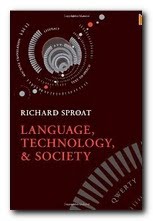 Most people think that writing and speaking a language are more or less the same thing - that writing is speech transcribed onto paper. The fact is that they are two different (though closely related) systems, and writing is an abstract system of symbols for representing the spoken language. There are some languages which are spoken but which have no written equivalents, and there are some languages (computer code for instance) which are never likely to be spoken. Richard Sproat, in this wide-ranging study, emphasises from the start that the most important connection between speech and the written language is the technological invention of writing. He takes the radical line that most written languages have built into them a strong element of encoding the sound of the language - including even Chinese, which many people imagine to be entirely ideographic... more >>
 Language is itself a code. In its writtten form it's an abstract set of signs to represent speech, and in its spoken form an extremely complex set of rules for making intelligent communication using sounds. But if that isn't complex enough, human beings seem to have a natural tendency to make things even more complicated by inventing all sorts of games, variations, and tricks with language. It's amazing how far the examples in Barry Blake's study of this phenomenon go back - certainly to the earliest days of written languages, which have themselves now become a sort of secret code which must be deciphered.
Rather surprisingly, many of the early examples of word squares and double acrostics he discusses come from curse tablets which people believed were effective for anything from defeating fellow athletes in competition, to curing the bite of a rabid dog.
Read more >>
 Henry Fowler's Dictionary of Modern English Usage was first published in 1926. It was an immediate success on publication, selling 60,000 copies in its first year, and it went on to become the most influential set of guidelines on grammar and the use of the English language of the twentieth century. There were later versions revised by Sir Ernest Gowers in 1965 and Robert Burchfield in 1996, but this is a facsimile of the original first edition. It's reproduced photographically from the original - so the entries are arranged in two columns on the page, which was the style for books of this kind at the time. This presentation strikes me as doubly appropriate, because it captures the old-fashioned nature of the original, and it accurately reflects the slightly pedantic tone of the contents. Fowler is not unlike his great lexicological predecessor Samuel Johnson in issuing his judgements wrapped around with ironic asides, which makes for interesting reading... Read more >>
 Truth be told, this is quite an advanced book on language written from deep within the research vaults of the English linguistic history, but it's written in a language that most people will be able to understand. Behind the apparently frivolous and amusing selection of examples, Jeremy Butterfield is offering a serious update on how lexicography is conducted in the digital age. Dictionaries are no longer constructed from contributions handed in on slips of paper by enthusiastic amateurs: they are compiled by software programs crunching vast stockpiles of words stored in databases - known as the 'corpus'. This is a collection of examples of how the English language is actually being used, drawn from the printed word - from literary novels and specialist journals to everyday newspapers and magazines, and from Hansard to the language of chatrooms, emails, and weblogs... Read more >>
 Many people who do not speak English as a first language struggle to understand English texts. Human translation is expensive. Machine translation (MT) frequently does not work. Global English offers a solution to these three related problems. Many good style guides exist. Why do technical writers need another guide to writing style? Unlike other guides, this book covers grammatical structures, not only particular terms. The book has more than 200 pages of text (plus 4 appendices) that give detailed explanations of both good practice and bad practice.
John Kohl writes clearly, and he explains the reasons for the guidelines. His guidelines are based on practical work at SAS Institute, where he works as a technical author... Read more >>
 This is the latest of Susie Dent's annual surveys of new words and expressions in English. This year her collection is offered in A—Z format — from adventure running to YAOI: that is, from extreme sports to Japanese gay manga porn. The activities which seem to have generated the most durable coinings this year are global finance, social networking, and ecology — all of which have hardly been out of the headlines in the last twelve months. Many of the new words will clearly not survive the fashions and whims which give rise to them — such as the rather cumbrous churnalism to describe the lazy recycling of unchecked stories in the press. And yet the reason for such a term's appearance is quite interesting.
Because of staff cuts, journalists now have to fill up to three times as much column inches of copy as they did in the 1980s. The same sort of etymological goodie occurs in the case of earmarxist - a critical term used for those politicians who designate funds for their own special projects. The term comes from the literal marking of an ear which was once used to identify livestock.
At the other extreme are terms whose success lies precisely in the fact that they are not attached to some fashionable phenomenon — and which can conversely attach themselves promiscuously to a variety of others — such as the prefix eco- in eco-warrior, eco-terrorist, and eco-town.
Two other things I was glad to learn from this year's collection were that organic matter had been discovered on a planet outside the solar system (an exoplanet) and that a femtocell offers enhanced communication access in areas with weak signal strength.
This is a spirited attempt to keep up with the rapid state of language change. I always enjoy these annual surveys, and as usual found it difficult to put the book down. I was also glad to note that this year an index had been provided.
Susie Dent, Words of the Year, Oxford: Oxford University Press, 2008, pp.148, ISBN 0199551996
 Do you know the past tense of the verb to dive? Is it dived or dove? Don't worry - nor would most native English speakers. The same is true of the verb to dream. Is it dreamed or dreamt? That's even less of a worry - because both are correct. This guide offers straightforward, up-to-date guidance on questions of English usage, all affecting the language we choose. Common confusions such as uninterested and disinterested are explained, differences between British and American practice are highlighted, and it takes a realistic attitude towards famous examples such as splitting infinitives, ending a sentence with a preposition, and when it is correct to say you and me or you and I... Read more >>
 The other day I overheard a young girl of around eight ask her mother "What's a phoneme?" Not surprisingly, her mother didn't even understand the question. And the girl added, "I think it's part of a word" - which was not a bad shot.This made me realise just how deeply the teaching of formal grammar was back in our national curriculum. And when I thought of the poor teachers having to implement this policy, my heart sank on their behalf. I think Deborah Cameron would understand and sympathise with this feeling, because this book is aimed specifically at existing and would-be classroom teachers. They now have the unenviable task of introducing what is essentially the study of linguistics into the daily life of schoolchildren... Read more >>
 Do you know what illecebrous, langsuir, and telematology mean? No - I thought not. They are 'attractive', 'female vampire', and 'the study of peat bogs' respectively. Not a lot of people know that. You might say that not many people would want to know that. But if you are one of the exceptions - people who are fascinated by etymology, unusual words, and obscure terms - this is the book for you. It's a collection of really out-of-the-way lexical items and words you have probably never heard of before. Entries run from abligurition (spending a lot on food) and abnormous (18th century, 'mis-shapen') to zoonosis (disease transmitted from animals to humans) and Zyrian (a north Russian language) ... Read more >>


