
Showing posts with label short stories. Show all posts
Showing posts with label short stories. Show all posts
16 February 2014
Edith Wharton tutorials


24 April 2012
A Master of Modernism

The full review is
29 November 2011
Short Stories by Henry James

For devotees of the short story, we've just launched several explanatory guides to the work of Henry James. Actually, the stories are not short by modern standards, but they have the distinction of all being very good. The Best in the Jungle is quite well known. It's about a man who has a presentiment that something momentous lies ahead for him in life, but he doesn't know what it will be. Not so well known, but amazingly contemporary in its relevance is The Papers which concerns, would you believe, journalists making up stories for newspapers to generate publicity for would-be celebrities. Four Meetings is an almost tragic tale of a gullible American schoolteacher who has a dream of seeing Europe but is conned out of it by an unscrupulous relative. Two stories are about women in relation to ships. In Pandora a spirited young American woman tweaks the nose of a young German diplomat who she meets on a cross-Atlantic liner, whilst in The Patagonia a similar young woman throws herself overboard rather than meet the man to whom she is going to be married. The Bench of Desolation is not nearly so gloomy as its title suggests, Fordham Castle is a story of an advanced form of social climbing - by pretending to be somebody else - and Daisy Miller is another of his acknowledged masterpieces about Americans in Europe, with the eponymous Daisy breaking social taboos at a cost to herself. Every one a gem, and a tribute to an author known to other writers simply as 'The Master'.
28 February 2011
Virginia Woolf's early stories
 The latest offering in our book reviews is a charming collection of short stories written in the earliest phase of Virginia Woolf’s career as a writer of modernist fiction when she was only twenty-four years old. Up to that point she had only produced essays and book reviews (some for my home city newspaper, the Manchester Guardian). And in fact the spirit of the reflective essay lingers over these meditations and fictional constructs which have in common the role of women in society. More >>
25 February 2011
Jorge Luis Borges
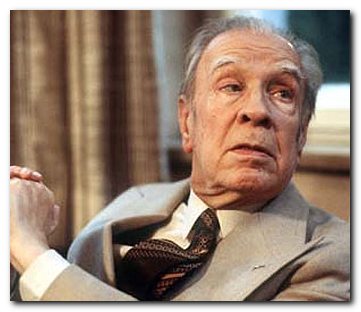
We have a new set of materials featuring the great Argentinean writer Jorge Luis Borges - one of the few authors to create an international reputation on the strength of only having written short stories. The first two item are a short biographical study and a review of The Total Library. His life was full of curious paradoxes (a rhetorical trope which he often features in his stories). He was made head of the National Library - just at the time he became blind; and he lived most of his life with his elderly mother - though he was married twice. Because he only wrote short stories, many people assume that he didn't write very much, but in fact he never stopped writing - producing book reviews, essays, journalism, film reviews, and philosophic studies. The Total Library is an impressive collection of this output, ranging from his earliest newspaper articles from the 1920s to pieces he wrote shortly before his death in 1986.
16 June 2010
Bloomsday 16 June 2010

I'm honoured to celebrate Bloomsday 16 June - the day of Ulysses and Joyce's first meeting with his wife Nora - by publishing a study guide to Dubliners. It's here
12 September 2009
Woman Who Did - the New Woman 1890-1914
 The short story came into its own as a literary genre at the end of the nineteenth century, as the three-decker novel died its death and the rising numbers of magazines and journals created a new market for shorter fiction. Moreover, the short story, as Angelique Richardson points out in this charming collection, "was concerned with questions rather than answers [and] was perfectly suited to give expression to the turbulence and uncertainties of the late nineteenth century". This was also the age which gave rise to the 'new woman' - the female who claimed her independence, wore what clothes she liked, flirted openly with men, smoked cigarettes, and rode a bicycle. These are the issues which form the background to this very entertaining compilation of stories from the fin de ciécle, which only really ended with the start of the First World War. Editor Angelique Richardson offers an expansive introduction which explains the developments that were taking place at that time and puts the stories into a rich context...Read more >>
20 August 2009
The Awakening and Other Stories
 Kate Chopin was an American writer who is now best known for her novel The Awakening (1899) which was 're-discovered' in the 1960s. But in fact she was a professional and quite successful author in her own lifetime who earned part of her living by placing her short stories with magazines. Her stories embrace the modern tradition, created in the late nineteenth century, of describing situations or dramatic episodes, then leaving them to speak for themselves. Without doubt she was what many people would call 'ahead of her time'. It is no surprise that with the reassertion of women's rightful place in cultural history which occurred in the 1960s, she was seen as an unjustly neglected figure. And reading her stories today, it's amazing how fresh and modern they seem, My guess is that she will now retain her place in the literary canon... Read more >>
15 June 2009
Maupassant's Short Stories
 Guy de Maupassant was a prolific and very famous writer in his own lifetime. Between 1880 and 1891 for instance he wrote about 300 short stories, 200 articles, six novels, two plays, and three travel books. He wrote in the heyday of the short story, and it is this literary form for which he is now best remembered. Maupassant was one of the late nineteenth-century writers shaping what was to become the modern short story. His contribution to the genre was to pare down the means of expression and to focus on the effect of the tale. His stories are not abbreviated novels or rambling prose poems. They tell a story - and often it has a sting in the tail. Like other French writers of the late nineteenth century he was keen to explore ordinary everyday life - often exposing its less appetising and even grim features... Read more >>
16 January 2009
A Smile of Fortune - Joseph Conrad
 Joseph Conrad is essentially a nineteenth century writer who anticipated and then lived into the modernist age of the early twentieth century, helping to shape its spirit of uncertainty, anxiety, and moral ambiguity. Even his own life and works share the contradictions of the era. He is best known as an author of mannish sea tales, yet he only achieved success with a novel set entirely on dry land which had a woman as its central character (Flora Barral in Chance). He is now regarded as a great figure in the tradition of the English novel, yet he was Polish, and English was his third language. He's also regarded as something of a conservative, yet his political views were scathingly radical (see The Secret Agent).
A Smile of Fortune comes from his mature period (1911) and features the familiar Conradian device of a young sea captain who is confronted by a puzzling ethical dilemma. The first person narrator is a confirmed bachelor given to a philosophic approach to life, but whom Conrad cleverly makes vulnerable to the duplicities of the more experienced people around him... Read more >>
04 June 2008
The Ghost Stories of Henry James
 Towards the late period of his long and astonishingly productive life, Henry James wrote a number of mystery or ghost stories. In these he combined his skills at controlling narrative and point of view with his penchant for puzzling and ambiguous situations. This collection contains some of the most famous tales - 'Sir Edmund Orme', 'Owen Wingrave', 'The Friends of the Friends', and his best-known shorter work, 'The Turn of the Screw'. They all deal with ghosts (or the supernatural) in a non-conventional manner, in that they hold a narrative interest whether you find the ghosts believable or not. And none of them rely on any conventional notions of spookiness or ghastly apparitions for their ... Read more >>
21 February 2008
Writing Short Stories - book review
 Can creative writing actually be taught? There is some debate about this question, but the number of university departments devoted to the subject is expanding so rapidly, many people must believe it's possible. And why not? After all, we believe that the skills of painting, music, and architecture can be taught, don't we. Ailsa Cox teaches creative writing, and this book is her version of a seminar - analysing the technical details of stories, then suggesting exercises which students (or readers) might complete to develop their own skills. She kicks off with a good shot at defining the short story. How short is short? How long can a story be before it becomes a novella or a short novel? There are no simple answers to these questions. As soon as you think of an answer, you'll realise there are exceptions... Read more >>
Subscribe to:
Posts (Atom)


