
more books on CONTEMPORARY SLANG

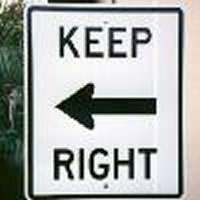
One of the things that sends me into a civic rage is the visual pollution of our streets and highways by the absurd decisions of local council planning departmentss. One is meaningless road markings - such as those politically correct but completely useless cycle paths which go nowhere and no sane cyclist would use. Or how about those huge white stripes to indicate bus lanes which are only operational for a short while in the rush hour. [And since almost all bus companies are now completely commercial, why should they be given any priorities?] Another which I am going to start photographing is the sprouting of income-generating commercial advertising on roundabouts, adding to the visual clutter the motorist has to decipher.
So I was glad to note that a group in Warrington have a deeply ironic web site devoted to those mad cycle lanes which if followed would lead you to nothing but a certain death. See them here at FACILITY OF THE MONTH
Actually, Great Manchester also features in an item I spotted recently on the amusingly nerdish Pathetic Motorways site. This lists motorways which are hidden, secret, unfinished, unbuilt - and in Manchester's case the shortest in the UK - a 300 metre stretch of the Mancunian Way flyover. See them HERE


 I made an unexpected discovery recently. It's the singing and piano playing of Patricia Barber. She offers a mixture of jazz, classical, and torch songs - and I particularly like John McLean, her smokey John Schofield-like guitar player. She comes from Chicago, and her father was a saxophonist with Glenn Miller's band. Her lyrics are witty, poetic, and sexually ambiguous. Although it's probably a politically incorrect thing to say, she's like a white Cassandra Wilson. And I understand from her web site that she is very much of the distaff persuasion. Listen for yourself at Amazon.


The power of bloggers to do what dead tree publishers dare not do has been tested today - and the bloggers won. Just in case you hadn't noticed, The News of the World brought out legal injunctions, forbidding anyone to publish pictures of their so-called investigative journalist Mazher Mahood, the 'fake sheik' who is much given to disguising himself as an Arab prince in order to dig the dirt on minor celebs.
He tried it last weekend with George Galloway - but Georgeous George rumbled him and is currently after his blood.
When the NOTW riposted with the attempted injunction, radical political blogger Guido Fawkes spotted an illegal attempt to curb free speech and promptly published pictures of the fake sheik on his blog.
What was the result? The Queen's solicitors were employed to threaten Guido with a 'cease and desist' notice - to which he replied Fuck off Farrers, and encouraged others to do likewise.
And they did. The bloggers posted snaps, cartoons, and jokes about this slimeball journo all over the net today. By late afternoon the gagging order was thrown out in court, and the bloggers had won.
Well done Guido! The match may not actually be over yet, but certainly game and set to you today.
Actually, this story has got potential legs. More to come, d'you think?
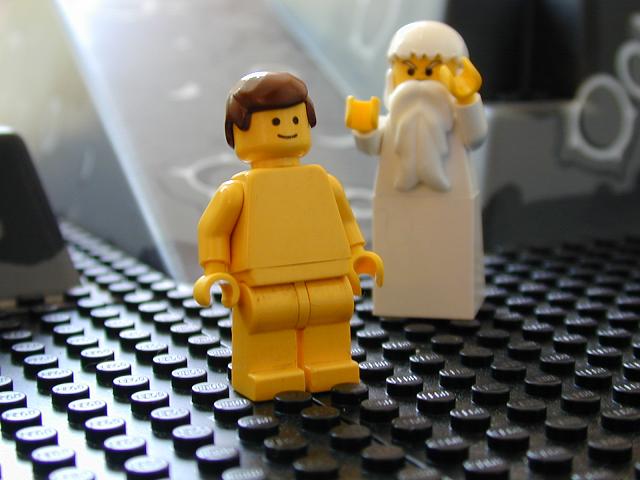 The story of the Bible - Old and New Testaments - illustrated in comic-book Lego scenes, complete with cinema-type ratings: N = nudity; S = sexual content; V = Violence; and C = cursing.
  Great novelists, such as Graham Greene for example, have an uncanny ability to express and interpret their times: what we know as the zeitgeist. I'm not sure if Pamuk is in that category yet, but on the basis of this outstanding novel it seems this is where he is heading. In real life Pamuk has recently been taken to court for claiming, rightly, that the government of his country sanctioned the murder of over a million Armenians during the First World War. This absurd case was eventually dropped, but with this book Pamuk remains controversial by focusing on the key issue of our time: the relationship between Islam and western values. And he doesn't have any easy answers. As he he says in one of his more lapidary statements: 'People who seek only happiness never find it.'
A well known poet and journalist, Ka, visits the ancient eastern Turkish city of Kars in order to write about the spate of suicides among young girls. He makes contact with people he knows in the city, shrouded in a snowfall which has also cut it off from the rest of the country. Isolated, twixt west and east in this city, a drama is played out which is a microcosm of the wider conflict between the secular and the religious.
He meets the beautiful Ipek, daughter of hotelier Turget Bey and former wife of the leader of a small Islamic political party, in The New Life Pastry Shop. They talk about Ka's life as a Turkish poet in Germany and Ka begins to feel a strong attraction for her - later to be consummated by an affair.
Here in the café, they see the widely respected Director of Education shot by an extremist for being a suspected atheist and for preventing girls entering his institute wearing headscarves in accordance with the Koran. The conversation between the old man and his assassin before the fatal shots are fired is a perfect summation of the conflict which provides the theme of the book. The device used of a novelist friend recalling all these events through notebooks and interviews, creaks a bit but overall works reasonably well.
Kars, we discover, is a hotbed of the political and the religious, all mediated through the extraordinary personalities we meet. Ka recites a poem at a televised festival at the National Theatre in which a dramatized conflict turns into a real one in with shots fired and people killed.
A local coup, it transpires, has been engineered by elements loyal to Kemal Ataturk, the charismatic early 20th century president of Turkey who established the republic, emancipated women and fought to replace a feudal religious culture with the secular, modernizing rationalism of Western Europe.
Ka has personal contacts, at varying levels of intimacy, with the people involved - the fading actor with a burning ambition is to play Ataturk; the fugitive revolutionary Islamist, Blue; a number of his disciples from the Religious High School; the sinister secret service men who seem to have the whole city bugged and regards torture merely as standard interrogation; and Ipek's sister, Kadife, who champions the 'headscarf' girls.
The drama - no less than Huntingdon's Clash of Civilizations - is played out in the streets and cafes of this ancient city whose history has involved invasion, resistance and multiple ownership by Mongols, Russians and Armenians as well as Turks.
Ka flits from scene to scene, his status as a leading poet allowing him privileged access but what is happening is always confused, unclear as if the all-enveloping snow keeps events out of focus until they happen. Indeed, the title of the book is eponymous in the sense that Kars is Turkish for 'snow' and perhaps it symbolizes how the fierce struggle between rational west and Islamic east has been cloaked and preserved by obfuscating, historical layers of the stuff.
Pamuk is excellent at giving both sides of the argument powerful and equal expression. Anyone wishing to understand the baffling conflict between those fierce conviction stares of young Islamic fundamentalists and ourselves in the West should read this book. Read for understanding that is: solutions would be too much to ask even of a novelist of Pamuk's rare gifts.
Guest review by Bill Jones who blogs at SKIPPER
Orhan Pamuk, Snow, London: Faber, 2004, pp.440, ISBN 0571218318


